
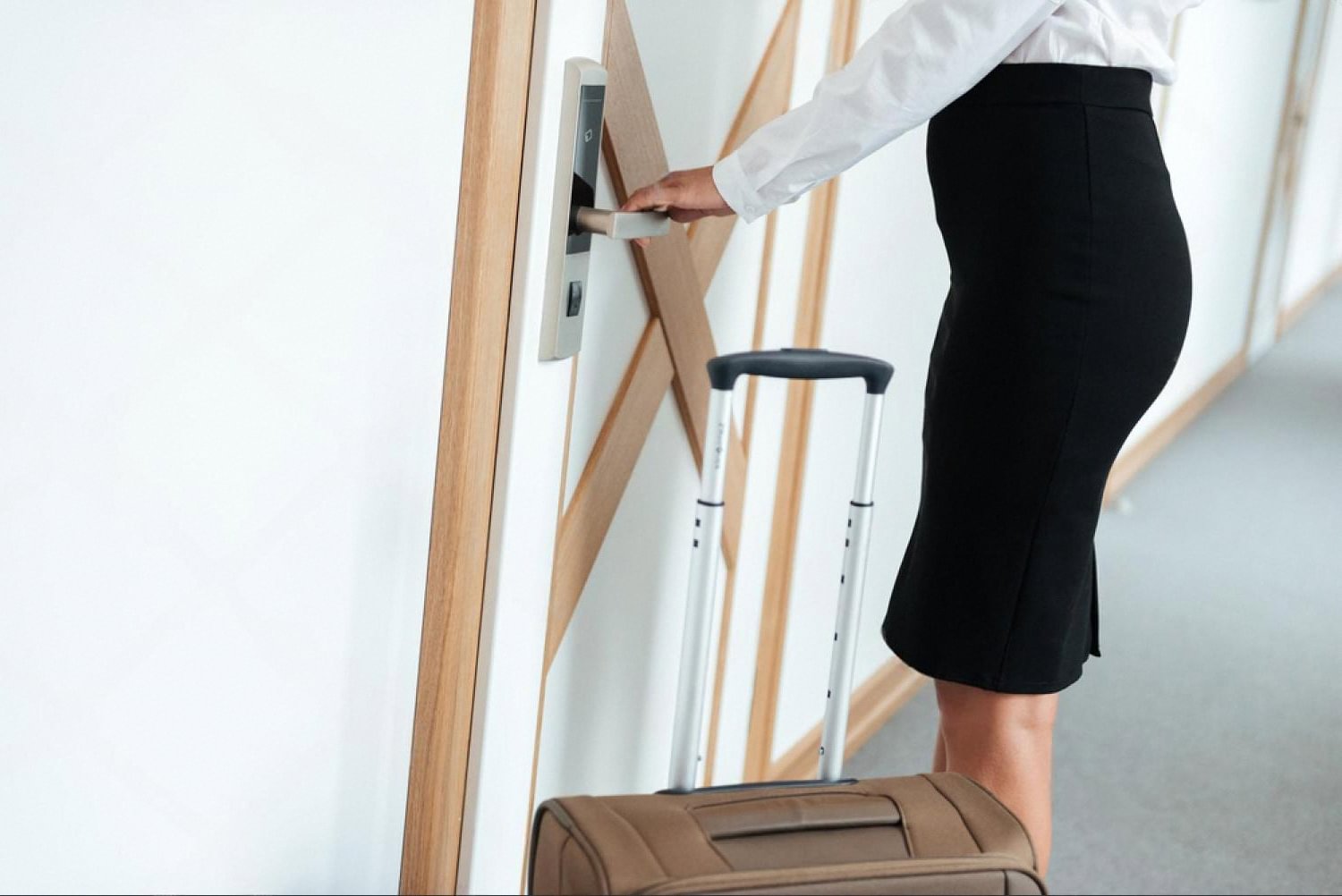
Hospitality tech
The plastic key card is quietly being replaced
Major US chains have rolled out phone-based room entry across thousands of properties. The question is no longer whether digital keys work, it’s whether the front desk still needs to print a card at all.
A decade ago, the magnetic-stripe card was the universal symbol of arriving at a hotel. Today, guests at Hilton, Marriott, Hyatt and a growing list of independents can walk past the front desk, head straight to the elevator, and open their room with a phone. The shift hasn’t been a flashy launch, it has been a slow bleed of plastic out of the system. To understand whether the key card is really dying, it helps to see how the new technology actually works and where the trade-offs sit.
How a hotel digital key actually works
A mobile key is not one technology, it’s a stack. When you complete hotel digital key setup inside an app like Hilton Honors or Marriott Bonvoy, the hotel’s property management system assigns a room and issues a credential to your phone. That credential is an encrypted token, not a static code, and it has an expiry tied to your checkout date.
When you approach the door, the phone talks to the lock over Bluetooth Low Energy or, on newer locks, NFC. The lock verifies the token against its own clock and the room assignment, then opens. Apple and Google wallet integration takes it one step further: the credential lives in the secure element of your phone, the same chip that handles payment cards, and you don’t even need to launch the hotel app.

Under the hood
Three pieces of tech do the work
- Bluetooth Low Energy. Lets the phone unlock from a few feet away. Good range, gentle on battery.
- NFC. Tap-to-unlock, the same protocol behind contactless payments. Faster and more precise than Bluetooth.
- Wallet integration. Apple Wallet and Google Wallet store the room key like a boarding pass, so it works even with the phone locked and the app closed.
Digital keys vs plastic cards: the honest trade-off
Where digital keys win
- No queue at check-in for repeat guests
- Lower long-term cost: no card stock, no encoders to replace
- Revoked instantly if a phone is lost
- No plastic landfill from forgotten cards
- Audit trail of every unlock event
Where the key card still has a point
- Works on a dead battery, kids’ phones, or no phone at all
- Familiar to every age group, no app download
- Easy to hand off to a second guest or housekeeping
- No dependency on the hotel’s Wi-Fi or app servers
- Lower up-front cost for small independent hotels
Are digital keys secure?
Security is the question that comes up most often, and the short answer is that a well-implemented mobile key is harder to clone than a magnetic-stripe card. Stripe cards have been a known weak point for years. In the 2014 Black Hat conference, researchers showed how a handheld device could open millions of Onity locks, the kind installed in roughly a third of US hotel rooms at the time. The industry has moved to RFID and encrypted cards since, but the underlying principle still applies: a static credential is easier to copy than a rotating one.
Mobile keys use rolling encrypted tokens, secure elements on the phone, and tie the credential to a specific guest account. If your phone is lost, the hotel can revoke the key from its system in seconds, which is something they can’t do with a card already in someone’s pocket. The remaining attack surface is mostly social: phishing the guest’s account login. That’s why most chains layer in two-factor authentication and tie the key to the same device used to log in. The PCI Security Standards Council treats hotel app credentials with the same seriousness as payment data, which has pushed brands toward tighter mobile security overall.
Cost, maintenance and the environmental math
A standard RFID key card costs a US hotel roughly 30 to 80 cents to produce, depending on volume and branding. A 300-room property with 70% occupancy and a four-night average stay burns through tens of thousands of cards a year, because most guests never return them and many are demagnetized and thrown out anyway. Add card encoders at the front desk, replacement plastic, and the staff time to re-encode keys that stop working, and the recurring spend is real.
Digital keys shift that cost. The hardware investment is up-front: smart locks that support Bluetooth and NFC, integration with the property management system, and the brand’s app. After that, issuing a key has no marginal cost. On the environmental side, the EPA estimates that PVC, the material in most key cards, is one of the least-recycled plastics in the waste stream. A typical card weighs around 5 grams, and across the US lodging industry that adds up to thousands of tons of plastic a year that mobile keys would never produce.
A short implementation guide for hoteliers
- Audit your locks. Many existing locks from Assa Abloy, Dormakaba and Salto can be upgraded with a BLE module rather than fully replaced.
- Integrate with your PMS. Your property management system needs to talk to the lock vendor’s cloud so a reservation can issue a credential automatically.
- Pick a credential format. Decide whether you support in-app keys only, or Apple and Google Wallet as well. Wallet adds friction at setup but removes friction at the door.
- Plan the fallback. Keep card encoders at the front desk for guests without smartphones, dead batteries, or families that need a second key.
- Train the front desk. The most common failure point is staff who don’t know how to troubleshoot a Bluetooth pairing or reissue a digital key.
Where to focus next
Pilot one floor
Don’t rip-and-replace. Run digital keys on a single floor for 90 days and measure unlock failure rates, guest adoption, and front-desk queue times.
Keep cards as backup
Even Marriott and Hilton still hand out cards on request. Plan for a hybrid model that probably lasts another five to ten years.
Measure the ESG win
Track plastic eliminated and report it in your sustainability statement. Corporate travel buyers in the US increasingly score hotels on this.
So, is the key card obsolete? Not quite. It’s becoming the backup, the spare, the option for the guest who left their phone charging in the car. The center of gravity has clearly moved to the phone, and for hoteliers the calculation is no longer if but when. For guests, the practical advice is simpler: download the app before you arrive, opt in to mobile key during online check-in, and skip the desk.
Frequently asked questions
Are digital hotel keys secure?
Yes, in most cases they are more secure than a traditional magnetic-stripe card. Digital keys use encrypted, rotating tokens tied to your guest account and your specific device, and they can be revoked from the hotel’s system the moment you report a lost phone.
The main risk is account-level: if someone takes over your hotel loyalty account, they could potentially issue a key to their own device. That’s why brands require two-factor authentication and tie keys to a known device.
How do hotel digital keys work?
You check in through the hotel’s app, which assigns you a room and sends an encrypted credential to your phone. When you walk up to the door, the phone communicates with the smart lock over Bluetooth Low Energy or NFC, the lock verifies the credential, and the door unlocks.
On wallet-enabled hotels, the key lives in Apple Wallet or Google Wallet, so you can unlock the door even with the phone locked and the hotel app closed.
Which US hotels use digital keys?
Most major US chains now support some form of mobile key. Hilton has rolled it out across more than 5,000 properties, Marriott Bonvoy supports digital keys at most of its brands, and Hyatt, IHG and Wyndham have all expanded their programs. Coverage is strongest at full-service and upscale brands, less consistent at limited-service properties and independent hotels.
What happens if my phone dies during my stay?
Every hotel that offers digital keys still keeps physical key cards as a fallback. Just visit the front desk, confirm your identity, and they will encode a card for you in under a minute.
It’s a good idea to ask for a backup card at check-in anyway if you’re traveling with family or sharing the room.
Do I need to download an app to use a hotel digital key?
Usually yes. The hotel brand’s app is what handles online check-in, assigns your room, and delivers the credential. Once the key is issued, some hotels let you push it to Apple Wallet or Google Wallet so you don’t need to open the app at the door, but the initial setup still happens in the brand app.
Are hotel digital keys cheaper for hotels than key cards?
Long term, yes. The up-front investment in Bluetooth and NFC-capable locks plus PMS integration is significant, but once it’s in place, issuing a key costs the hotel nothing. Plastic cards, in contrast, run roughly 30 to 80 cents each, and most are never returned, so a busy 300-room property spends thousands of dollars a year just on card stock.
Will plastic hotel key cards disappear completely?
Not in the next several years. Hotels need a fallback for guests without smartphones, for kids, for shared rooms, and for moments when an app or Wi-Fi goes down. The realistic future is hybrid: digital keys as the default, plastic cards available on request, and the volume of plastic produced dropping steadily each year.

Hello! My name is Michael Thompson, and I am an entrepreneur from Canada who opened my business in Dubai. The UAE is known for its dynamic economy, favorable environment for investors, and innovative business landscape. After many years of dreaming about my own business, I decided and launched my company here.